

AARA reporting and approving processes
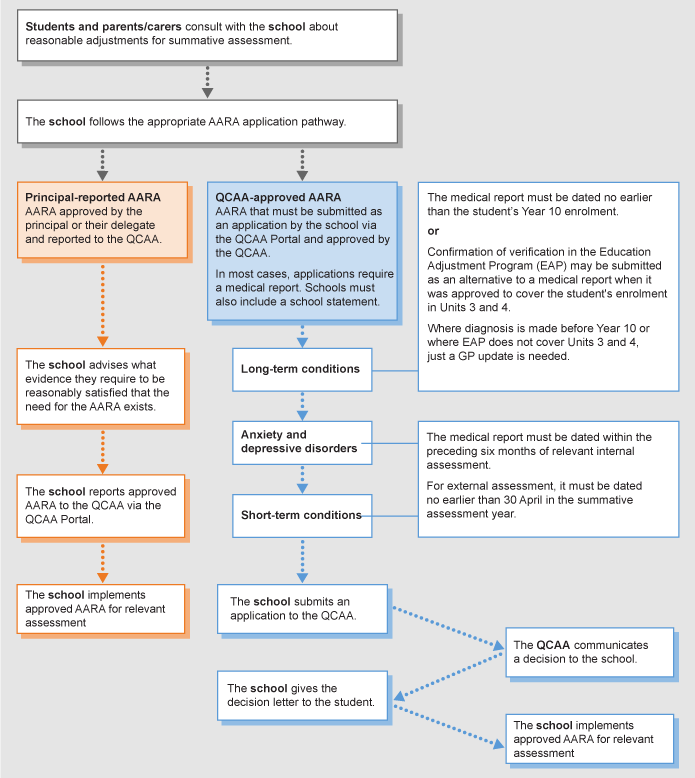
Schools complete AARA applications and submit them to the QCAA via the QCAA Portal on behalf of students. Students and parents/carers consult with schools and provide required supporting documentation. Applications are submitted to the QCAA for assessment in Units 3 and 4 only. For assessment in Units 1 and 2, all AARA decisions and processes are school based.
Illness and misadventure in external assessment
Fiona Baker
Manager, AARA unit
Hello everyone. I’m pleased to take a moment to explain how the QCAA ensures every student receives fair and accurate subject results, especially when unexpected events occur.
Each year, some students face circumstances that affect their ability to sit an external assessment or perform as expected. This could be due to illness, school closures, fire evacuations, or other unforeseen events beyond a student's control.
When this happens, schools submit what’s called an illness and misadventure application to the QCAA. Students are still eligible to apply even if they haven’t missed an exam.
Our team carefully reviews every application and communicates the outcome to schools, who then inform students.
Once an application is approved, we apply a well established set of procedures to calculate the student’s final subject result. These procedures aim to account for the individual student’s situation while ensuring every result remains fair and comparable across the whole cohort.
Before students sit external exams in October and November, they have already completed either 50 or 75 percent of their total assessment, depending on the subject. Those internal assessment results form the starting point for our calculations.
We then use statistical analysis to examine how students with the same internal assessment results performed on the external assessment. This helps determine a fair and expected external result for a student affected by illness or misadventure, whether or not they were able to attend the exam.
This approach preserves consistency. Students who perform strongly throughout the year can be confident their final result will reflect that performance.
We assure all students, their teachers and their families that this process is rigorous, transparent and fair.
Principal-reported AARA
Principal-reported AARA are specific practical arrangements and adjustments authorised by the principal or principal’s delegate for an eligible student.
Assessment | Principal-reported AARA |
|---|---|
Internal assessment |
|
Internal and external assessment |
|
*QCAA approval is required for these AARA only for the CIA (common internal assessment) for Applied (Essential) subjects.
QCAA-approved AARA
QCAA-approved AARA are specific practical arrangements and adjustments that must be approved by the QCAA.
Assessment | QCAA-reported AARA |
|---|---|
Internal assessment |
|
The common internal assessment (CIA) in Applied (Essential) subjects |
|
| External assessment |
|
More information
More AARA resources are available, including:
- a short video — Understanding AARA
- a factsheet — Introduction to AARA (PDF, 232.6 KB).
- Last updated:
- 30 January 2026
